
Why Risk Intelligence Is Becoming Essential for
Businesses in Southeast Asia
Over the past decade, Southeast Asia has transformed into one of the most dynamic business regions in the world. Indonesia, Singapore and Malaysia continue to attract foreign investment, expand digital infrastructure and develop cross-border commercial networks. But alongside opportunity, complexity has increased.
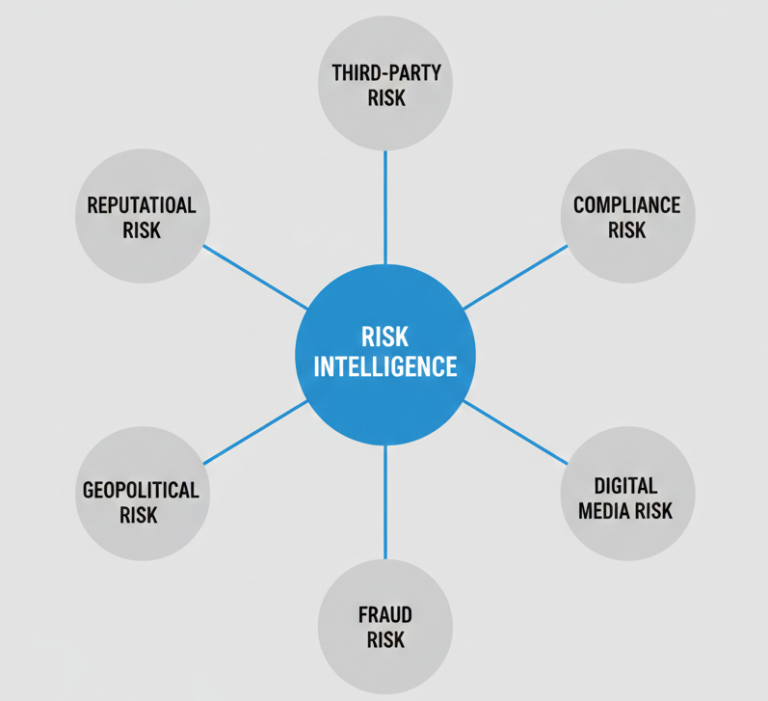
For organisations operating in this environment, risk is no longer limited to financial exposure or regulatory compliance. Reputational concerns, third-party integrity issues, fraud risks and geopolitical uncertainty have become part of everyday business decisions.

The Changing Nature of Business Risk
Traditionally, risk management focused on internal controls. Companies implemented policies, audited financial statements and relied on compliance checklists. While those measures remain important, modern risk exposure often originates outside the organisation.
Today’s risks frequently arise from:
- Third-party vendors and suppliers
- Joint venture partners
- Acquisition targets
- Rapidly hired workforce expansion
- Digital information environments
- Public perception shaped by media and social platforms
In emerging markets, where regulatory frameworks are evolving and information transparency can vary, identifying these risks early is critical. Risk intelligence allows organisations to move beyond assumption and operate based on verified insight.
What Is Risk Intelligence?
Risk intelligence is the structured process of gathering, analysing and interpreting information to identify potential threats before they escalate.
Unlike routine background checks or compliance reviews, risk intelligence takes a broader view. It may include:
- Reputational assessments
- Adverse media analysis
- Third-party due diligence
- Integrity reviews
- Corporate relationship mapping
- Cross-border exposure analysis
The goal is not simply to uncover negative information, but to understand context how potential risks could affect operations, partnerships or long-term strategy.
Why Southeast Asia Requires a More Nuanced Approach
Southeast Asia’s economic growth has outpaced regulatory uniformity. Each country operates within its own legal, cultural and political landscape. Practices acceptable in one jurisdiction may present compliance concerns in another.
For example:
- Vendor onboarding practices vary widely
- Corporate transparency levels differ
- Local enforcement procedures may not align with international standards
- Informal business networks can influence decision-making
For multinational companies expanding into Indonesia or partnering with regional firms, this complexity demands careful evaluation.
Risk intelligence provides clarity in environments where publicly available information alone may not be sufficient.
The Cost of Reactive Risk Management
Many organisations still respond to risk only after a problem becomes visible — a compliance breach, a public scandal, a failed partnership or an internal fraud incident.
By that stage, consequences may include:
- Financial loss
- Legal exposure
- Regulatory penalties
- Damaged client relationships
- Long-term reputational harm
Preventative risk assessment is almost always less costly than reactive damage control.
A structured intelligence approach helps decision-makers assess potential exposure before entering agreements, hiring senior personnel or expanding into new markets.
The Future of Risk Management in the Region
As Southeast Asia continues to integrate into global markets, scrutiny from international regulators, investors and clients will increase. Transparency expectations are rising, and digital information flows faster than ever.
In this environment, businesses cannot rely solely on traditional compliance checklists. They must adopt forward-looking risk strategies that combine local understanding with global standards.
Risk intelligence will increasingly serve as a strategic advantage enabling organisations to act with confidence rather than uncertainty.
Conclusion
In a region defined by growth and complexity, informed decision-making is a competitive differentiator. Risk intelligence enables organisations to navigate uncertainty, identify exposure early and strengthen governance across operations.
For businesses operating in Indonesia and the wider Southeast Asian market, proactive risk assessment is no longer optional. It is an essential component of responsible expansion and sustainable success.
Frequently Asked Questions
- What is risk intelligence in a corporate context?
Risk intelligence refers to the structured process of gathering and analysing information to identify potential operational, reputational, regulatory and third-party risks before they impact the organisation. It supports informed decision-making at strategic and operational levels. - How is risk intelligence different from traditional compliance checks?
Traditional compliance focuses on meeting regulatory requirements. Risk intelligence goes further by proactively identifying emerging threats, reputational exposure and third-party vulnerabilities that may not be visible through standard compliance reviews.
- Why is risk intelligence particularly important in Southeast Asia?
Southeast Asia presents diverse regulatory systems, evolving governance frameworks and complex cross-border relationships. Businesses operating in the region face heightened exposure to third-party, reputational and political risks, making structured intelligence essential.
- When should a company conduct risk intelligence assessments?
Risk intelligence is most valuable before major decisions such as entering new markets, forming partnerships, onboarding high-level executives, engaging third-party vendors or pursuing mergers and acquisitions.
- Does risk intelligence replace internal risk management processes?
No. Risk intelligence strengthens internal controls by providing external insight. It complements governance, compliance and audit functions by identifying risks that may not be captured internally.
How Veris Can Help
Veris supports organisations across Southeast Asia with structured risk intelligence and investigative advisory services. Our approach combines local insight with global standards to help businesses identify reputational exposure, third-party risk and operational vulnerabilities before they escalate.
👉 Contact our team to discuss how PT Veris can support your risk intelligence and corporate advisory requirements.